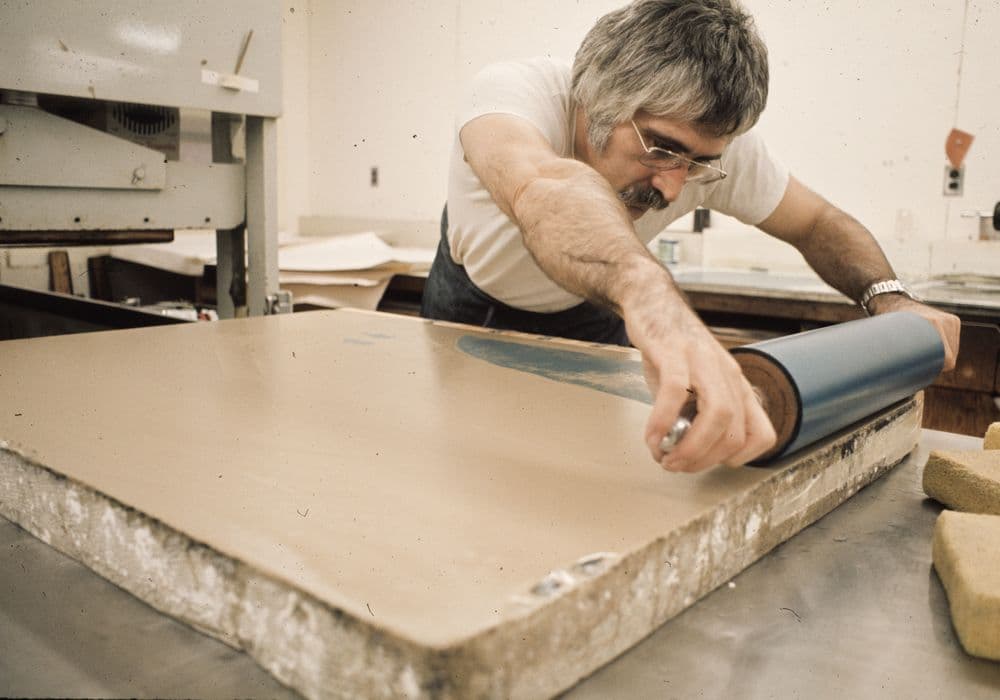
Michael Heizer at Tyler Graphics Ltd, Bedford Village, New York, 1977
Gift of Kenneth Tyler 2002
Photographer: Lindsay GREEN
Michael Heizer is known primarily as the sculptor whose monumental earthworks erected in the vast desert expanses of the American Midwest marked the beginning of the Land Art movement of the 1960s. An artist who is celebrated for liberating art from the confines of the gallery space, Heizer has also maintained a more conventional painting and printmaking practice. Several of his print series feature in the Kenneth Tyler Collection.
Heizer has always worked with geometric shapes. His earliest paintings were large, single–coloured, shaped canvases that protruded from the wall, lending the work a sculptural quality that he went on to develop on a massive scale. In 1969, working in the remote Nevada desert, Heizer made the series Primitive dye paintings, in which bright, powdered dyes were spread over the dry desert landscape, covering large areas that when viewed from the air formed amorphous, organic shapes. Later that year Heizer began to create ‘negative’ sculptures by cutting directly into the earth. Double negative of 1969–70 consists of two massive, rectangular trenches dug on either side of a large mesa.
The trenches are visible from space and their construction involved the shifting of 240 000 tonnes of earth and rock. Heizer began his ambitious City project in 1972. The project, which, as the title suggests, will ultimately result in a massive sculptural city, continues today.
Heizer’s prints in the National Gallery’s collection complement his sculptural work and illuminate his preoccupation with geometry and natural forms. The Circle prints investigate geometric form by dissecting the sphere into interlocking triangles and rectangles. This idea is furthered in the Paper collage series, where the circle is created by the collaging of various off–cuts from previous printing projects. All of the Circle works are executed in tones that recall Heizer’s preoccupation with earth; deep browns and ochre yellows are complemented by basalt blacks and steely greys.
Emilie Owens
- Photo Archive
- Tyler Graphics Publications
- Related Links
Emilie Owens, 2007
This chronology provides an overview of selected biographical information, major solo and group exhibitions held within the artist's own lifetime.
Last updated May 2013